A Princess Shaped by Dynasty
Margaret Theresa of Spain was born on 12 July 1651 in Madrid, inside the Royal Alcazar. Her arrival mattered far beyond family sentiment. She entered the world as a dynastic instrument, a ceremonial emblem, and a possible answer to imperial uncertainty. In the Spanish Habsburg court, birth rarely meant privacy. It meant scrutiny, calculation, and expectation. Margaret Theresa lived beneath that pressure from the first hour.
Her life unfolded in a court built on etiquette, spectacle, and political tension. Spain still projected majesty, yet succession worries had already begun to gnaw at its foundations. Margaret Theresa stood within that contradiction. She was both cherished and deployed. Her existence linked Spain to Austria, and later to Bavaria through her descendants. That lineage gave her a place in European history that outlasted her brief life.
Philip IV and Mariana of Austria
Margaret Theresa’s father was Philip IV of Spain, a ruler who understood pageantry as an arm of governance. He presided over a court where art and authority reinforced one another. Power in his realm was not merely exercised. It was staged with precision. His daughter was born into that atmosphere of calculated grandeur.
Her mother, Mariana of Austria, was Philip IV’s niece as well as his wife. That marriage reflected the Habsburg preference for internal union. It was intended to conserve rank and preserve dynastic coherence. Mariana was younger than Philip IV, and her position carried severe political weight. She was expected to produce heirs, and the survival of those heirs mattered immensely.
Margaret Theresa was the first surviving child of that union. Her birth brought relief, but not certainty. The Spanish succession remained unstable, and every child became a political fact. Within the royal household, infancy itself was a strategic condition. Survival could alter treaties, expectations, and inherited claims.
A Family Marked by Loss
Margaret Theresa grew up among siblings whose lives were unevenly shadowed by mortality. Her elder full sister, Maria Theresa of Spain, later became Queen of France through marriage to Louis XIV. That union tied Spanish Habsburg blood to the French crown. It also revealed how princesses functioned as diplomatic conduits.
Her older half brother, Balthasar Charles, Prince of Asturias, had already died in 1646. His death intensified the Spanish succession crisis before Margaret Theresa was born. The absence of a stable male heir reverberated through the court. Every later child carried that vacancy into the future.
Several younger siblings died very young. Maria Ambrosia de la Concepcion Enriqueta Teresa did not live long enough to shape politics. Ferdinand Thomas Charles also died in infancy. Philip Prospero, born in 1657, briefly represented hope for the dynasty. His early death renewed the crisis once more. The family rhythm was harshly repetitive. Birth, expectation, frailty, and mourning followed one another in close succession.
Charles II of Spain was Margaret Theresa’s younger full brother and the most consequential sibling. He eventually became king, but his health was fragile and his reign tragic. His condition made the Spanish monarchy appear majestic and precarious at once. His existence ensured that Margaret Theresa’s family remained central to European affairs. Yet he also confirmed how vulnerable dynastic power could be.
Marriage to Leopold I
Margaret Theresa married Leopold I, Holy Roman Emperor, on 12 December 1666 in Vienna. Their proxy marriage had already taken place in Madrid on 25 April 1666. She was fifteen. Leopold was her maternal uncle and paternal cousin. Such kinship would be startling in modern terms, but it served political necessity in her world.
The marriage bound the Spanish and Austrian Habsburg branches more closely. It strengthened imperial solidarity and kept strategic claims within the family. These unions were not sentimental accidents. They were deliberate mechanisms of statecraft. Margaret Theresa’s marriage was one of the clearest examples of that practice.
Even so, their relationship appears to have held genuine warmth. Court accounts suggest closeness, affection, and shared regard. That human element matters. Many royal marriages were cold arrangements between thrones. This one seems to have allowed room for personal attachment. Margaret Theresa was not only transferred between courts. She was valued within her new household.
Maria Antonia and the Future of Claims
Margaret Theresa’s only child to survive infancy was Maria Antonia of Austria, born on 18 January 1669. She became the key vessel for her mother’s bloodline. In dynastic politics, a surviving daughter could be as consequential as a son. Maria Antonia carried Spanish Habsburg legitimacy into the next generation.
She later married Maximilian II Emanuel, Elector of Bavaria. That marriage extended Margaret Theresa’s influence into another major European house. Through this union, her line entered the intricate struggle over the Spanish inheritance. Maria Antonia became the mother of three children. Joseph Ferdinand of Bavaria survived childhood. Leopold Ferdinand of Bavaria and Anton of Bavaria died at birth.
Joseph Ferdinand briefly became one of the most important figures in Europe. His claim to Spain made him a possible solution to a vast succession crisis. That possibility did not endure. Even so, it proves how Margaret Theresa’s brief life echoed into continental politics. Her daughter and grandson carried her significance forward long after her death.
Court Life and Portraiture
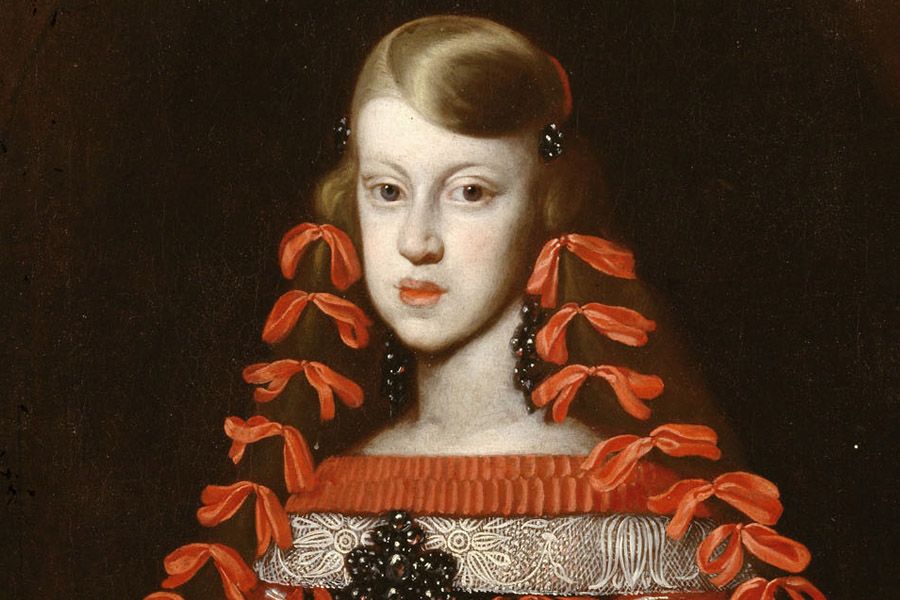
Margaret Theresa lived amid ceremony, display, and painterly attention. Diego Velazquez portrayed her as a child, and those images still shape her memory. The portraits are disciplined and luminous. They capture a figure suspended between innocence and formality. She appears both fragile and ceremonious, as if the court itself were resting on her shoulders.
Her life at court involved birthdays, state appearances, household management, and illness. She was presented with lavish observance from childhood onward. Her arrival in Vienna was treated as a major occasion. Even her clothes and attendants carried symbolic charge. Royal life in her era was never merely domestic. It was a theater of rank.
Yet the splendor could not protect her from bodily vulnerability. She became pregnant multiple times. Her health remained precarious. She died on 12 March 1673, at the age of twenty-one, while pregnant again. That ending was abrupt and severe. It cut off a life already compressed by duty and reproduction. Her short span gives her story a peculiar intensity.
The Wider Habsburg Web
Margaret Theresa cannot be understood apart from the wider Habsburg network. Her father, mother, siblings, husband, daughter, and grandson all belonged to a system of inheritance politics. That system relied on marriage, but also on survival. It produced splendour, yet it also produced exhaustion.
The Habsburg world linked Spain, Austria, France, and Bavaria through blood and strategy. Margaret Theresa stood near the center of that web. She was daughter of Philip IV and Mariana of Austria. She was sister to Maria Theresa of Spain and Charles II of Spain. She was wife to Leopold I. She was mother to Maria Antonia of Austria. She was grandmother to Joseph Ferdinand of Bavaria.
That chain of relations explains her historical importance. It also reveals the emotional cost of dynastic rule. The family was built around continuity, but continuity remained elusive. Children died early. Political hopes shifted quickly. Marriage solved one problem and created another. Margaret Theresa lived inside that unstable architecture.
Key Takeaways
Margaret Theresa of Spain was born in Madrid on 12 July 1651 and died on 12 March 1673. She lived only twenty-one years, yet her life touched several European thrones. She was a Spanish Habsburg princess, a Holy Roman Empress, and a pivotal dynastic figure.
Her parents were Philip IV of Spain and Mariana of Austria. Her siblings included Maria Theresa of Spain and Charles II of Spain. She also belonged to a family scarred by repeated infant and child mortality. That fragility shaped the political stakes around her birth.
Her marriage to Leopold I united the Spanish and Austrian Habsburg lines. Their only surviving child, Maria Antonia of Austria, carried the family into Bavaria. Through Joseph Ferdinand of Bavaria, Margaret Theresa’s lineage entered the later struggle over the Spanish succession. Her life was brief, but her political afterlife was extensive.