An Arkansas Beginning
Flossie Mae Harp was born in Arkansas in 1902, during a period when rural life still governed daily existence. Roads were rough, labor was relentless, and families learned endurance early. Her name itself feels rooted in that world. It carries the cadence of fields, kitchens, and plain spoken duty. She emerged from a household where kinship mattered more than display.
Her parents were John Bohannon Harp and Martha Frances Arizona Belle Villines Harp. That lineage places her inside a wide Southern family network that stretched across Arkansas and adjoining states. In such families, identity was rarely theatrical. It was built from obligation, memory, and survival. Flossie’s early life seems to belong to that older order.
Marriage and Domestic Formation
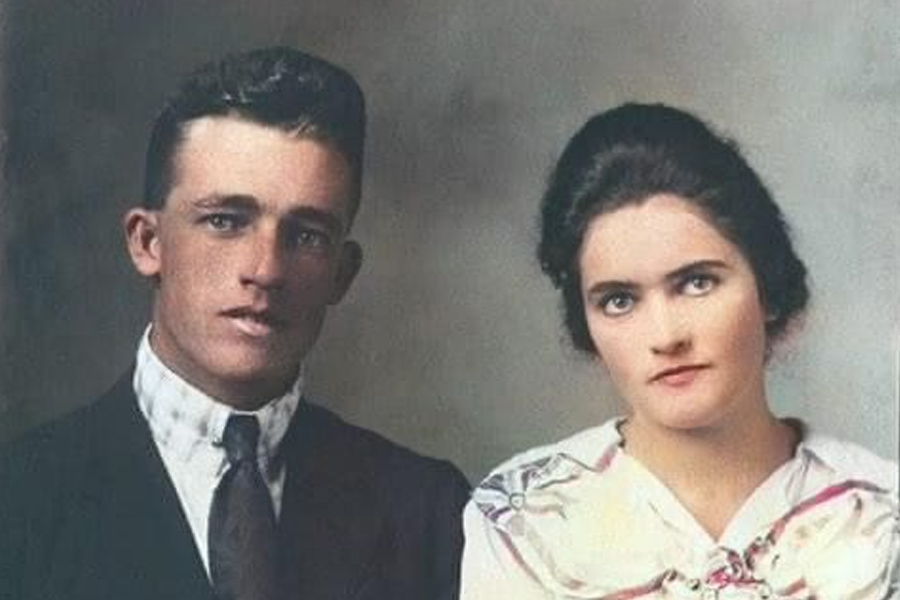
On 16 November 1919, Flossie married James Francis Haggard in Checotah, Oklahoma. She was only 17 years old. By modern standards, that age seems abrupt for marriage. In her world, it marked a common passage into adult responsibility. The marriage became the central frame of her life.
The family she formed with James was not cushioned by abundance. Their years together were shaped by work, movement, children, and hardship. Still, the household endured. That endurance matters because it often disappears from historical memory. Flossie helped create a domestic order that held through difficult decades.
Children and Household Legacy
Flossie and James had at least four children. Their names anchor the family record with clarity. Each child occupied a different place in the family narrative. Together, they reveal the breadth of her domestic role.
| Family Member | Relationship to Flossie Mae Harp | Notes |
|---|---|---|
| James Francis Haggard | Husband | Married in 1919 |
| Lillian Marie Haggard Rea | Daughter | Born 1921, lived until 2024 |
| James Lowell Haggard | Son | Born 1922, died 1996 |
| Flora Juanita Haggard | Daughter | Born and died in 1924 |
| Merle Ronald Haggard | Son | Born 1937, country music legend |
Lillian Marie gave the family a living bridge across nearly a century. James Lowell remained part of the family line, though public attention rarely centered on him. Flora Juanita’s short life adds a note of sorrow to the record. Merle Ronald would become the most visible name, yet his public life was shaped by the private world Flossie maintained.
Migration and Hardship
The family left Oklahoma for California in 1934. The move followed a barn fire and the grinding pressure of the Great Depression. It was not a journey of aspiration. It was an act of necessity. Many families in that era moved because staying became impossible.
By 1937, the family was living in a converted boxcar in Bakersfield when Merle was born. That detail is striking because it compresses hardship into a single image. A boxcar is designed for freight, not family life. Yet Flossie helped sustain a home there. That kind of domestic resilience rarely enters grand narratives, but it should.
The family’s move west also marked a transformation in their social environment. California offered possibility, but not ease. Poverty traveled with them. So did discipline, religious conviction, and the habits of survival already forged in the South. Flossie remained part of that moral architecture.
Faith Work and Endurance
The Church of Christ shaped the family’s interior life. That religious setting emphasized order, restraint, and accountability. Flossie appears to have embodied those values in the home. She was not ornamental in the family story. She was directive, steady, and foundational.
After James died in 1946, Flossie worked as a bookkeeper. That occupation reveals much about her character. Bookkeeping requires precision, patience, and attention to detail. It is practical labor, but also disciplined labor. In a family with limited means, it likely served as a crucial support.
Her life does not appear to include a public career or visible financial prominence. That absence should not be mistaken for insignificance. Many lives of real consequence never pass through fame. Flossie’s achievement was domestic, economic, and moral. She sustained a household through scarcity and loss.
Flossie and Merle Haggard
Flossie’s public recognition largely arrived through Merle Haggard. He became one of country music’s most resonant voices. His songs and stories turned his mother into a cultural figure. The song “Mama Tried” helped transform her into a symbol of stern maternal authority. That image is simplified, but it carries emotional force.
Merle’s artistry drew from the conditions that shaped him. Flossie was part of that formation. She represented discipline, belief, and a household ethic that left an indelible mark. The son’s public mythology cannot be separated from the mother’s private labor. Her influence helped build the emotional grammar of his work.
It is also worth noting how fame distorts memory. Merle’s renown made Flossie visible, but in a narrow way. Public attention tends to flatten complex lives into emblematic roles. She becomes mother, disciplinarian, influence, and little else. That is too limited. She was also a woman navigating grief, migration, poverty, faith, and survival.
Generational Reach
Flossie’s legacy extends well beyond her own lifetime. Through her children and grandchildren, she helped shape a family whose name remained recognizable for decades. Some descendants entered music and public life. Others remained largely outside the spotlight. The lineage itself shows how one household can radiate outward for generations.
| Generation | Names |
|---|---|
| Parents of Flossie | John Bohannon Harp, Martha Frances Arizona Belle Villines Harp |
| Flossie’s siblings | William Ollis Harp, Opal Harp Hiner, Flora Agnes Harp Newton, and others in extended records |
| Flossie’s spouse | James Francis Haggard |
| Flossie’s children | Lillian Marie, James Lowell, Flora Juanita, Merle Ronald |
| Flossie’s grandchildren through Merle | Dana, Marty, Kelli, Noel, Jenessa, Ben |
Family trees often look orderly when printed. Real families are not orderly. They carry grief, uneven memory, and shifting loyalties. Still, the structure matters. It shows how Flossie’s life extended into later generations in tangible ways. Her influence moved through bloodlines, habits, and stories.
A Life in Dates
A few dates outline her life with plain force. The sequence reveals how much she endured across eight decades. Each number marks a turn in the family’s story. The chronology itself is spare, yet it suggests an immense interior world.
| Year | Event |
|---|---|
| 1902 | Born in Arkansas |
| 1919 | Married James Francis Haggard |
| 1921 | First child born |
| 1922 | Second child born |
| 1924 | Daughter Flora Juanita born and died |
| 1934 | Family moved west to California |
| 1937 | Merle Ronald Haggard was born |
| 1946 | James Francis Haggard died |
| 1984 | Flossie Mae Harp died in California |
These dates do not explain everything. They do, however, provide a scaffold. Between them lies the fuller record of labor, faith, hardship, and maternal authority. That hidden span is where her life truly resided.
Family Identity and Southern Memory
Flossie Mae Harp belonged to a generation that often left few personal records. Many women like her are remembered indirectly. They survive in census lines, family recollections, and the achievements of descendants. That does not diminish their importance. It makes interpretation more necessary.
Her story reflects the rural South in the early 20th century. It reflects early marriage, religious seriousness, hard migration, and domestic burden. It also reflects the quiet force of women whose work seldom entered public archives. Flossie’s life was practical, yet not minor. She helped hold together a family under pressure.
The cultural memory surrounding her often centers on Merle. That focus is understandable, but incomplete. Flossie had her own historical gravity. She managed a household through displacement and widowhood. She raised children amid scarcity. She carried ordinary obligations with uncommon durability.
Key Takeaways
Flossie Mae Harp was born in Arkansas in 1902 and came from a large Southern family. She married James Francis Haggard in 1919 and raised at least four children. Her household endured depression, migration, poverty, and the death of her husband in 1946.
She later worked as a bookkeeper and lived much of her later life in California. Her most public association is with her son Merle Haggard, whose music drew deeply from the family atmosphere she helped create. Her legacy is not only musical. It is also domestic, generational, and moral.